 gensai.ai
In June 2026, for World Oceans Week, the SEA LIFE Paris Val d'Europe aquarium celebrated its 25th anniversary with the "Monsters of the Oceans" operation. Visitors could question the sea about its difficult cohabitation with humans through an interactive installation powered by an embodied voice AI.
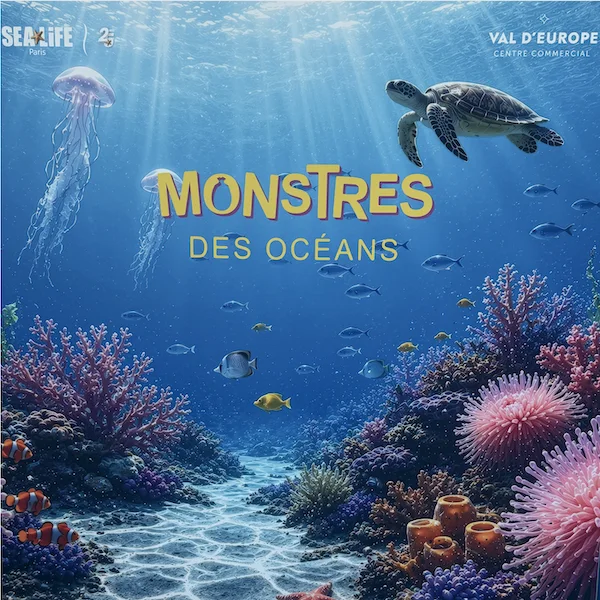
Behind this immersive experience lay a constraint few visitors would have suspected: the installation had no Internet connection at all.
All of the system's intelligence, from the question asked to the spoken answer, ran on a simple Mac Mini, plugged into a power socket. No cloud, no remote server.
For Gensai, which designed the installation alongside event agency Super Hérault, this choice reflects a simple principle: the right level of intelligence applied to the right problem does not always require the power of the cloud. Sometimes local, frugal AI is enough, and even proves more consistent with the message being carried.
"Monsters of the Oceans": an outreach experience for the general public
The project is as much about scenography as technology. The interactive installation is part of an event set-up designed for a busy venue, where the visitor journey must be legible in a few seconds and usable without assistance.
The usage principle is deliberately simple. The visitor walks up to a touch screen and asks their question in one of three ways: by selecting it from displayed suggestions, by typing it, or out loud through a microphone. The Sea answers both aloud and in writing: a choice about accessibility as much as atmosphere.
This logic of embodied visitor experience is directly relevant to event agencies, advertising agencies, cultural institutions and museums looking to renew their museography and cultural outreach. Gensai explores this ground regularly, as at SITEM in the Louvre.
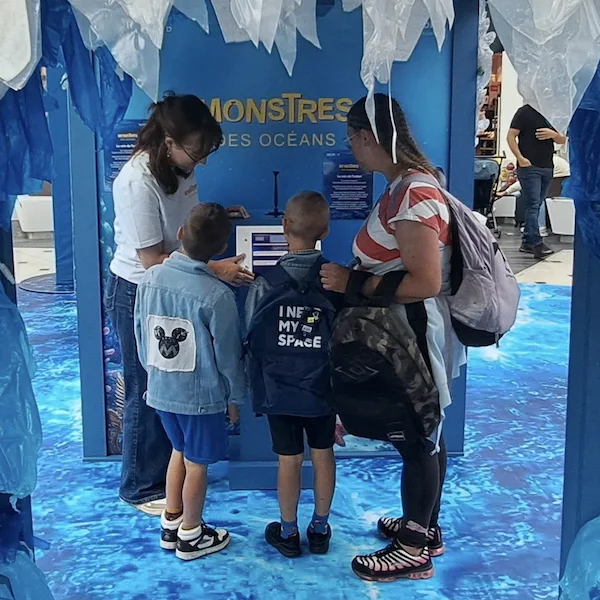
Why 100% local AI, with no Internet access?
Local AI (or "on-premise") is artificial intelligence that runs entirely on site, without transmitting any data to remote servers. A decisive asset for an event installation or a museum journey.
Three reasons guided this choice on the project.
The first is robustness. In a high-traffic venue, Wi-Fi is saturated and unstable. Depending on the network means risking a cut-off or latency with every answer, over two weeks of intensive operation. Running locally, the interactive installation stays smooth no matter what.
The second is confidentiality. No visitor's voice, no question ever leaves the machine: a sensitive subject in any public venue.
The third is sobriety. A request to a large cloud-hosted model mobilises servers and distributed energy consumption, billed by the token. Here, everything fits on a device the size of a book, plugged into a standard socket. Raising awareness about ocean preservation with frugal AI rather than an energy-hungry infrastructure: the means stayed consistent with the message.
An AI that answers from validated knowledge
Rather than letting the AI answer freely, Gensai relies on RAG (Retrieval-Augmented Generation): the AI draws its answers from a validated knowledge base rather than from its internal knowledge alone. This base (state of the oceans, biodiversity, pollution, ecological habits) was built and validated with the aquarium.
This control over content is essential for a cultural institution: the AI stays faithful to the scientific discourse, without drift or approximation. Faced with an off-topic question, the Sea stays in character rather than inventing.
The whole system works offline, on a computer sitting in the scenery. The quality of the visitor experience no longer depends on the connection, but on the accuracy of the content and the staging.
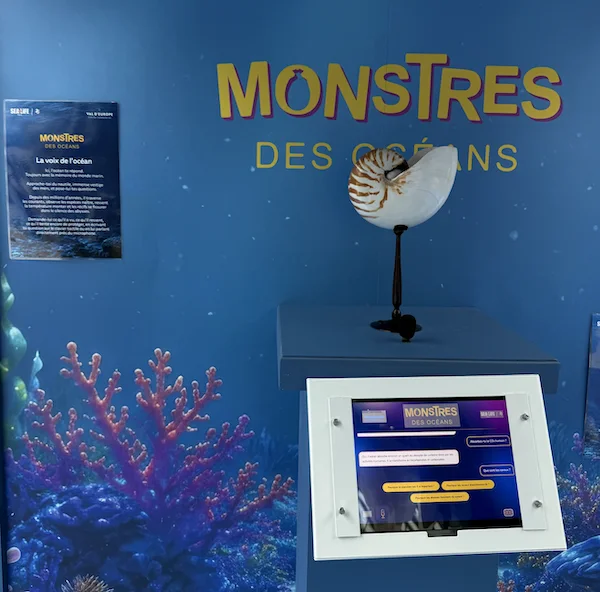
An embodied voice, by Gradium
The Sea's voice (deep, low, slightly cavernous) was generated by Gradium, the first spin-off of the French research lab Kyutai. Gradium develops voice AI models capable of natural, expressive interactions.
The choice is not incidental. Entrusting the voice of a scenographic installation to French technology follows the same logic as the rest of the project: quality, control and sovereignty.
Scenography, museography and AI: a playing field for agencies and institutions
Beyond the oceans use case, this project illustrates what AI brings to scenography and museography: a layer of interactivity that turns a passive visitor into an active interlocutor. A historical figure who answers, an artwork that tells its own story, an ecosystem that converses: event agencies, advertising agencies, museums and cultural institutions have here a new tool for outreach and immersive experience, deployable on a booth, a trade show, a temporary exhibition or a permanent journey alike.
The point is not to deploy the most powerful AI. The point is to deploy intelligence that is useful, reliable and sober, whose technical means remain consistent with what it stands for. For an installation dedicated to ocean preservation, making the Sea speak from a simple computer sitting in the scenery is not an imposed constraint: it is a demonstration. In immersive experience and outreach, technical sophistication never replaces the soundness of the choice.
Project designed by Gensai, in collaboration with the Super Hérault agency, for the "Monsters of the Oceans" operation at SEA LIFE Paris Val d'Europe. Voice generated by Gradium (Kyutai).