 gensai.ai
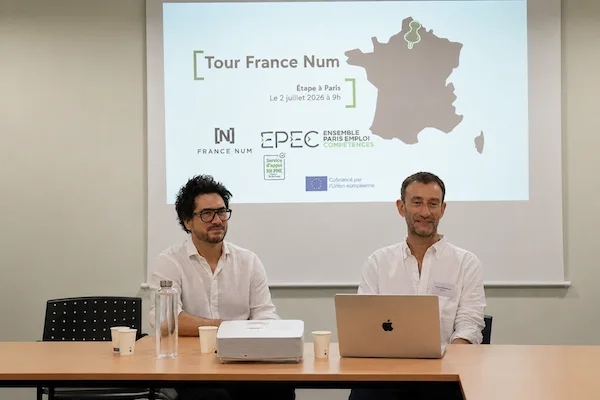
On 2 July 2026, EPEC hosted the Paris stage of the Tour France Num, alongside France Num, the government partnership initiative dedicated to the digital transformation of very small, small and medium-sized businesses. A morning devoted to economic security, cybersecurity, digital sobriety and artificial intelligence, in front of business leaders looking for concrete answers.
Gensai ran the "Productivity and digital sobriety" workshop, co-presented by Jérôme Reminiac and Sébastien Lecocq, co-founders of the studio and France Num activators. Three workshops ran in parallel: cybersecurity with the Gendarmerie nationale, a Café IA discussion with Studeria and the CCI Paris Île-de-France, and Gensai's.
Can you really boost productivity with AI without giving up digital sobriety and sovereignty? The answer came down to one idea: sobriety is not a brake on productivity: it is what makes it sustainable.
Digital sobriety and AI: a false opposition
Digital sobriety is not about renouncing AI. It is a choice of usage and architecture that eliminates waste without sacrificing the value produced.
The misconception is persistent: being sober would mean using less AI, and therefore giving up useful applications. Gensai argues for another reading: sobriety means the right usage and the right architecture, not deprivation.
Training a large model is very heavy, but it happens once. Day-to-day usage, on the other hand, is repeated billions of times a day: that is what weighs most at global scale. Text remains very frugal. Images and video weigh considerably more. Another simple lever: generating electricity in France emits roughly 20 times less CO₂ than the world average, which makes local hosting a sobriety measure in itself (source: RTE, IEA).
How to gain productivity without losing sobriety
The basic rule is simple: choose the model best suited to the need, not the biggest one available.
A Large Language Model (LLM) remains relevant for complex reasoning. But for FAQ, sorting or extraction, a small specialised model (SLM, for Small Language Model) is more than enough, at a fraction of the consumption. Architecture matters too: filtering upstream, automatically routing to the right model, or using RAG (Retrieval-Augmented Generation), a method that retrieves information from a document base before generating an answer, which avoids mobilising a large model for simple requests.
The use cases presented in the workshop illustrate this principle: an assistant that optimises delivery rounds saves fuel, AI that drives heating based on actual building occupancy cuts the energy bill, demand forecasting limits unsold stock, and predictive maintenance extends equipment lifespan.
Gensai applies this logic in its own work. The studio designed the Oceans project for the SEA LIFE Paris aquarium: an event installation where children could talk with "the Sea" and ask it about the difficult cohabitation between the oceans and human activity. The whole system runs entirely locally on a simple Mac Mini, with no cloud connection and no recurring usage cost, thanks to a small embedded model coupled with speech recognition and speech synthesis.
Sovereignty, the other pillar of responsible AI for SMBs
Digital sovereignty means keeping control of your data and your AI tools: a compliance issue (GDPR, AI Act) as much as a matter of trust with your customers.
For an SMB, this translates concretely: knowing where your data is hosted, avoiding dependence on a single supplier, and relying on French and European alternatives where relevant (Mistral AI for open models that can run locally, OVHcloud or Scaleway for hosting, or on-premise solutions for the most sensitive uses).
Gensai is currently working on a carbon-footprint tool designed to be accessible to the smallest organisations, built with sovereign models and favouring small, frugal models over oversized generic ones.
Why does the Tour France Num visit employment and SMB support networks?
The Tour France Num is a travelling programme that equips SMB leaders directly in the field on concrete digital issues: cybersecurity, economic security, sobriety, AI. The Paris stage was held at EPEC, operator of the support service for Parisian SMBs, in partnership with the Île-de-France regional Prefecture, DRIEETS, the Île-de-France Region and several consular networks.
Gensai took part as a France Num Activator, a status that acts as a public trust signal identifying qualified digital-transformation partners. The studio is also listed in the Hub France IA 2026 mapping, which identifies trusted artificial-intelligence players in France.
Sobriety and productivity: the takeaway
Digital sobriety applied to AI plays out on three levels: better usage (the right prompt, the right tool), better choice (the right model, at the right cost) and better design (filtering, routing, RAG, local execution where possible).
The point is not to do less AI. The point is to size AI to the right usage, so that it remains profitable over time, financially as well as ecologically.
Tour de France Num resources and event review